During Black Friday Cyber Monday 2025, Meta ads delivered a 2.26 ROAS across the stores Triple Whale tracked. That looks fine until you run it against a store with 40% margins offering 20% off. That store needs a 4.0 ROAS to break even, so at 2.26 every attributed sale lost money.
Nobody in Ads Manager flags that. The dashboard shows revenue climbing and a ROAS above 2, and the campaign gets scaled. The loss only shows up later, when someone matches ad spend against what the discounted orders actually earned.
Black Friday ads usually go wrong in three ways. The target number is wrong, ad sets launch too late to settle, or edits land during the busiest week of the year. Each one is fixable before November 27.
Are Facebook Ads More Expensive on Black Friday?
Yes. More brands compete for the same feeds during Black Friday week, and Meta’s auction prices rise with that demand. Triple Whale’s BFCM 2025 report, which covers more than 33,000 stores and $606.6 million in ad spend, shows what that looked like on Meta.
| Metric | BFCM 2025 result | Change vs. BFCM 2024 |
|---|---|---|
| Share of tracked ad spend | 67.6% | Slightly down from 67.81% |
| CPM (cost per 1,000 impressions) | $22.26 | Up about 7.8% |
| Cost per acquisition | $34.06 | Up 2.19% |
| ROAS | 2.26 | Up 3.18% |
| Median order value (AOV) | $77.79 | Up 4.44% |
Source: Triple Whale BFCM 2025 report, Meta ads across 33,000+ stores.
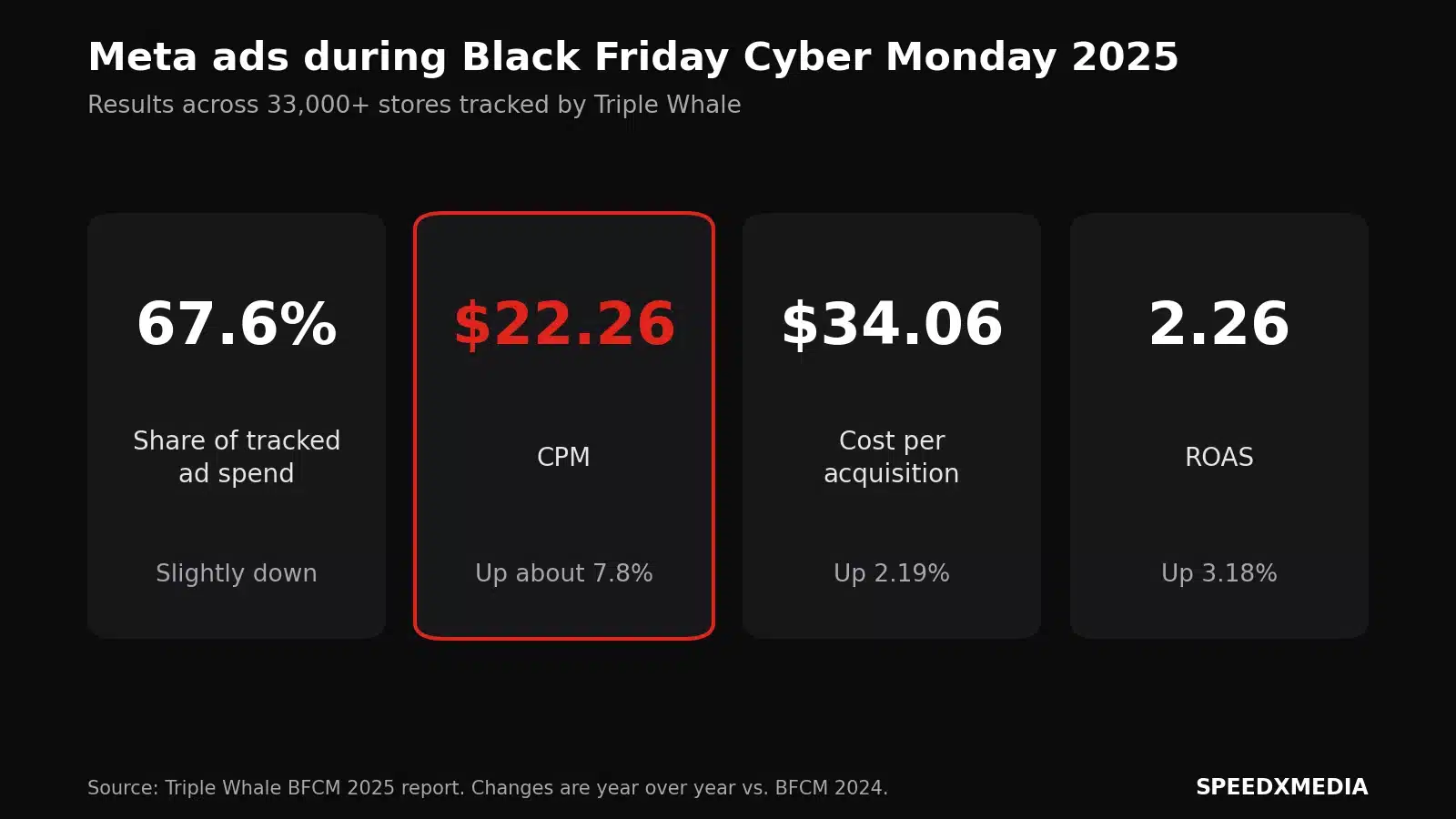
Two notes on reading this. These are year-over-year changes, Black Friday against last Black Friday, so they don’t show how far costs climb above a normal week. Triple Whale’s own advice is to budget with peak-period CPM and CPA estimates rather than average-week costs. And Meta still took two-thirds of the spend, which suggests advertisers keep finding the buyers there despite the premium.
Spend also starts early. Triple Whale counted $396.6 million in ad spend from November 24 to 27, 2025, before the Black Friday weekend began.
Your Break-Even ROAS Changes the Moment You Discount
Break-even ROAS is the return on ad spend where an ad stops losing money. At full price it equals 1 divided by your gross margin. A discount shrinks the margin on every order, so the break-even number rises.
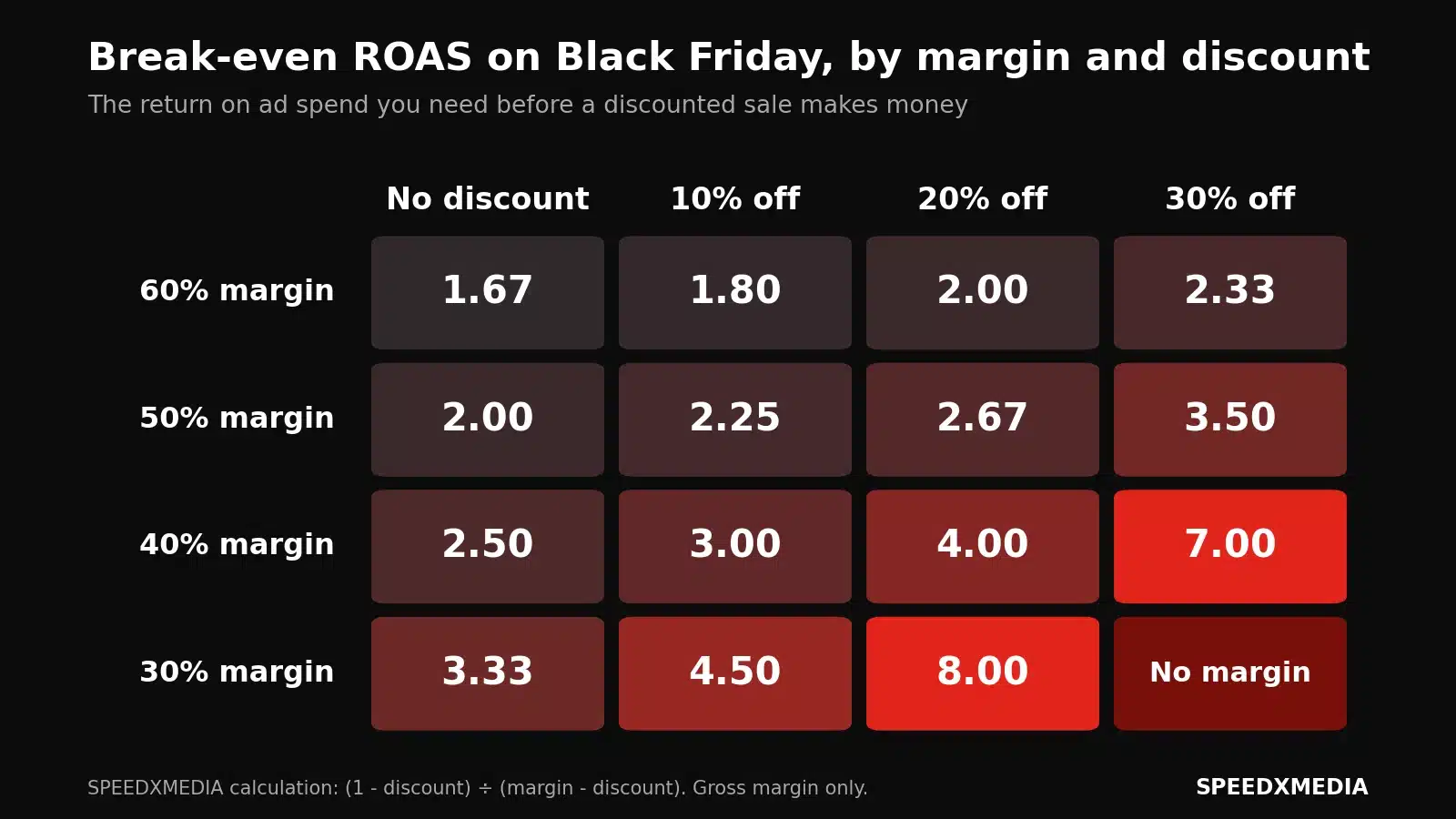
The formula with a discount is: break-even ROAS = (1 – discount) ÷ (margin – discount), using decimals. A 40% margin with 20% off gives 0.8 ÷ 0.2, which is 4.0.
Here’s how that plays out in dollars. A $100 product with a 40% margin earns $40 at full price. At 20% off it sells for $80 and earns $20. If the ads behind that sale cost $25, the ROAS is 3.2, which looks healthy in Ads Manager. The order still lost $5.
| Gross margin at full price | No discount | 10% off | 20% off | 30% off |
|---|---|---|---|---|
| 60% | 1.67 | 1.80 | 2.00 | 2.33 |
| 50% | 2.00 | 2.25 | 2.67 | 3.50 |
| 40% | 2.50 | 3.00 | 4.00 | 7.00 |
| 30% | 3.33 | 4.50 | 8.00 | No margin left |
SPEEDXMEDIA calculation. Gross margin only. Shipping, payment fees and returns push every number higher.
This is why fixed rules of thumb fail on Black Friday. A rule like “pause anything below 1.5 ROAS” would keep a 30%-margin store running ads that lose money on every sale at 10% off. The pause line has to come from your own margin and your own discount.
There’s a fair counterargument. A first order that loses money can still pay off if the customer buys again. If your repeat rate supports that, set the target with lifetime value in mind, but make the decision on purpose and write the number down. Our guides on what ROAS is and what counts as a good ROAS cover both calculations in more detail.
When to Launch Black Friday Facebook Ads
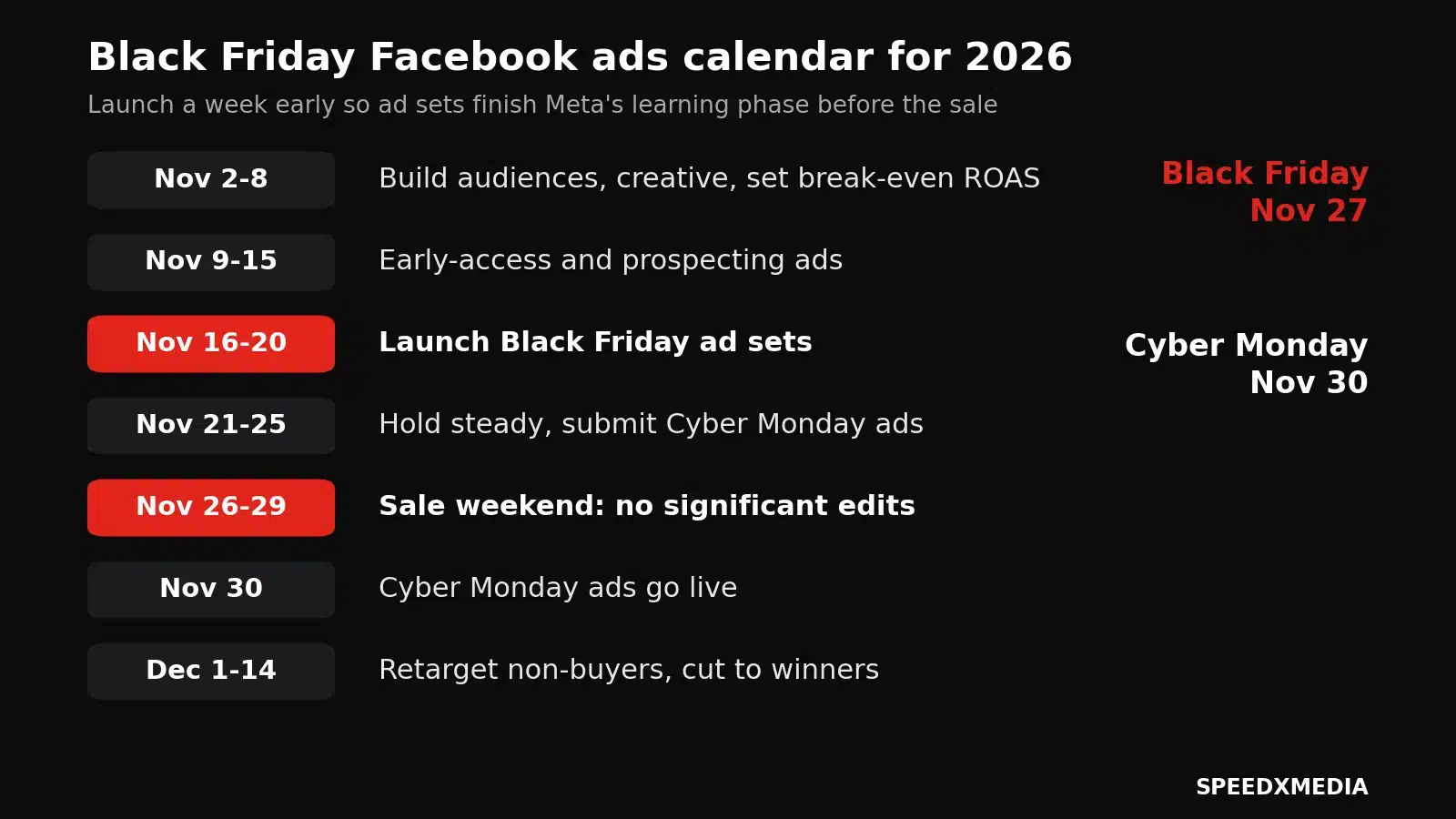
Launch your Black Friday ad sets about a week before the sale, around November 20 for 2026. Meta says an ad set usually needs about 50 optimization events in the seven days after its last significant edit to exit the learning phase. An ad set launched on Thanksgiving spends the most expensive days of the year still learning.
| Dates | What to do |
|---|---|
| Nov 2 to 8 | Build audiences, produce creative, set the break-even ROAS for your offer |
| Nov 9 to 15 | Run early-access and prospecting ads to grow retargeting pools |
| Nov 16 to 20 | Launch Black Friday ad sets with early-sale creative |
| Nov 21 to 25 | Hold steady and submit Cyber Monday ads for review |
| Nov 26 to 29 | Thanksgiving and Black Friday weekend, no significant edits |
| Nov 30 | Cyber Monday ads go live |
| Dec 1 to 14 | Retarget visitors who didn’t buy and cut back to proven ad sets |
Build in time for review too. Meta says ad review typically finishes within 24 hours but can take longer, and ads can be reviewed again after they go live. Submit sale-week creative at least two days before you need it.
Edits That Restart Learning
Changing creative, targeting, the optimization event or the bid strategy counts as a significant edit, and so does a large budget change. Each one puts the ad set back into learning. During sale week that means volatile delivery right when you can least afford it. If something needs to change, launch it as a new ad set and leave the stable one alone.
Smaller stores may never reach 50 purchases a week in a single ad set. If that’s you, optimize for a higher-volume event such as add to cart. Or consolidate into fewer ad sets so each one collects enough data.
Build the Audience Plan Around Warm Traffic
Warm audiences already know you, so they usually convert at a lower cost and get the first share of the budget. Plan three groups:
- Warm visitors: people who viewed products, added to cart or engaged with your ads and pages in the last 30 to 90 days.
- Past customers: your email list and recent buyers, with offers that suit people who already trust you.
- New prospects: broad targeting or lookalikes built on your best customers, launched early so they feed the warm pool.
Exclude anyone who bought in the last few days from acquisition ads, or you’ll pay to show a discount to people who already paid. Our guide to scaling Facebook ads covers broad targeting and lookalikes in more depth.
Black Friday Ad Formats That Keep Showing Up
Black Friday ads in Meta’s Ad Library tend to fall into a handful of formats. These five cover the jobs a sale needs done:
- Early access: a sign-up ad that sells a date and a perk, run in the first half of November.
- The offer as math: the original price, the sale price and the saving, shown in the first second.
- Gift or bundle: a free item or set above a spend threshold, which protects the margin better than a deeper cut.
- Last chance: a real deadline, run only in the final 48 hours so it stays believable.
- A new reason for Cyber Monday: a different product, bundle or angle, so returning shoppers see something new.
Design every version for a phone first. Adobe expects 63% of Thanksgiving online spending to come through mobile devices in 2026, so vertical video and big, readable offers aren’t optional.
Budget Rules for Sale Week
Set the sale-week budget before Thanksgiving, then stop touching it. These rules keep spend under control without constant edits:
- Use campaign-level budgets so Meta can move spend toward winning ad sets without manual changes.
- Pause an ad set only when it runs below your break-even ROAS for a full day. Purchases keep arriving after the click, so hourly numbers mislead.
- Keep proven evergreen ads running next to the sale ads.
- Hold back some budget for Cyber Monday instead of spending it all on Friday.
For how to raise budgets on winners without breaking them, see our guide on scaling Facebook ads without killing ROAS.
Can Service and Lead-Gen Businesses Run Black Friday Ads?
Yes, with a different target. A service business optimizes for leads, so the number to know is the most you can pay per lead and still profit. Multiply the profit from one client by your lead-to-client close rate. If a client is worth $3,000 in profit and you close 20% of leads, you can pay up to $600 per lead to break even.
Pair that with an offer that doesn’t cut your rate. A rate lock for clients who sign before December 31 works, and so does a bonus deliverable for January starts. Our Black Friday marketing strategy guide covers those offers in more detail.
Cyber Monday and the Week After
Treat Cyber Monday as its own launch. Adobe forecasts it as the biggest online shopping day of 2026, and shoppers who saw your Black Friday ads need a new reason to click. Run the fresh creative you submitted earlier and point it at warm audiences first.
After Cyber Monday, cut back to your proven ad sets and retarget people who visited during the sale but didn’t buy. December shoppers still respond to modest offers and shipping deadlines.
Final Thoughts
Black Friday rewards the brand that knew its break-even number before the auction got expensive and had stable ad sets before the traffic arrived. The work that protects ROAS happens in the two weeks before Thanksgiving. Sale week is mostly about leaving things alone.
Work With SPEEDXMEDIA
SPEEDXMEDIA runs paid social with the creative produced by the same team that manages the budget, so Black Friday ads are built, approved and stable before sale week. If you want your break-even ROAS and launch calendar checked before November 27, contact SPEEDXMEDIA or call 442-4-SPEEDX. We’re based in Burbank and work with brands across Los Angeles.