A shopper looks at your product on a Tuesday night, gets a text, and closes the tab. They meant to come back. They won’t, unless something reminds them.
That’s the job of retargeting. Done well, it’s a helpful nudge at the right moment. Done badly, it’s the same banner following someone around the internet for a month after they already bought the thing.
What separates the two is the strategy behind it: who you show ads to, for how long, with which message, and when you stop.
What Is a Retargeting Strategy?
A retargeting strategy is a plan for re-engaging people who have already interacted with your brand. It defines which audiences to target and how long each person stays in an audience. It also sets what each group sees, how often and how you’ll measure results. Turning on a single “all website visitors” campaign is a tactic. A strategy treats each level of intent differently.
Retargeting vs. Remarketing: What’s the Difference?
The terms overlap, and many marketers use them interchangeably. When people separate them, retargeting usually means paid ads shown to people who visited your site or engaged with your content. Remarketing usually means reaching people you already have a relationship with, often through email.
| Retargeting | Remarketing | |
|---|---|---|
| Usually means | Paid ads to people who interacted with your site, app or content | Re-engaging known contacts and past customers |
| Main channels | Meta, Google Display, YouTube, LinkedIn | Email, SMS, customer list ads |
| How people are identified | Pixels, tags and cookies | Email addresses and customer data you collect |
| Best for | Visitors who left without buying | Customers and subscribers you can contact directly |
Google Ads calls its own retargeting lists “remarketing,” which is one reason the terms blur.
In practice, a good strategy uses both. Paid retargeting catches people you can’t email yet. Email and SMS reach people who already gave you permission.
Who to Retarget: The Segment Matrix
Not every visitor deserves the same ad. Someone who reached checkout is days away from buying. Someone who read one blog post is months away. Treat them the same and you either annoy the first or waste money on the second.
| Segment | Window | Message | Offer | Frequency |
|---|---|---|---|---|
| Checkout abandoners | 1 to 7 days | Finish your order, with shipping and returns info | A small incentive after day 3, if any | High, short burst |
| Cart abandoners | 1 to 14 days | The exact product, plus reviews | Usually none in the first 48 hours | Medium |
| Product viewers | 7 to 30 days | Benefits, reviews and related products | None | Medium |
| Content readers and video viewers | 30 to 90 days | The next useful piece of content or a case study | None | Low |
| Email subscribers who haven’t bought | 30 to 90 days | Best sellers and a reason to make a first order | A welcome offer | Low |
| Past customers | 30 to 180 days or longer | Complementary products, refills, referrals | A loyalty perk | Low |
SPEEDXMEDIA recommended starting points. Adjust windows to your own buying cycle.
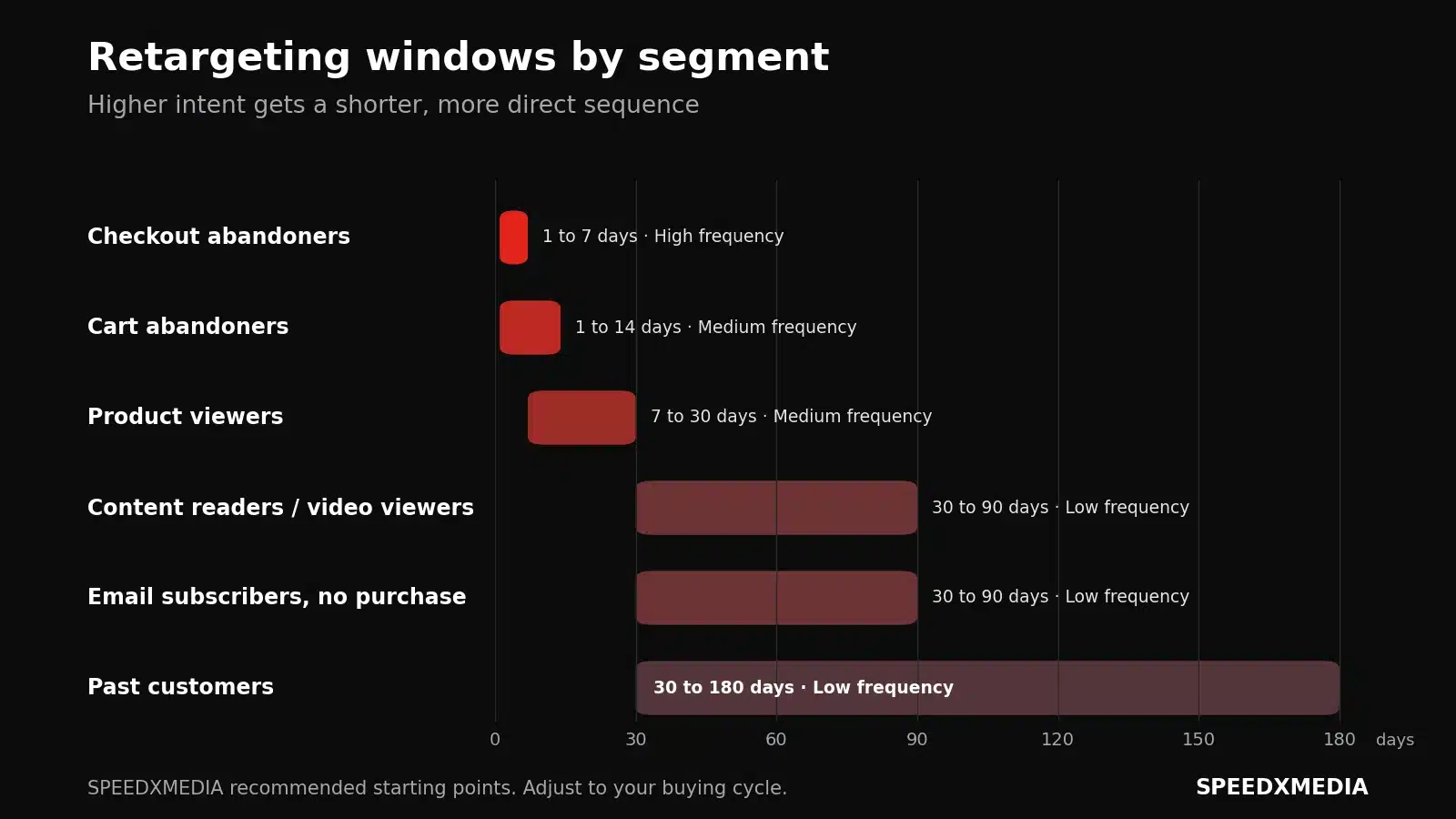
Two rules sit behind the matrix. The closer someone got to buying, the shorter and more direct the sequence. And discounts come last, if at all, so you don’t train shoppers to abandon carts on purpose.
How to Build a Retargeting Strategy, Step by Step
Here’s the build order we use:
- Set up tracking properly. Install the Meta Pixel with the Conversions API and the Google tag. Track the events that matter: product views, add to cart, checkout and purchase.
- Build audiences by intent, using the segment matrix above as a starting point.
- Add exclusions before you launch. Remove recent buyers, people already in a higher-intent segment and your own team.
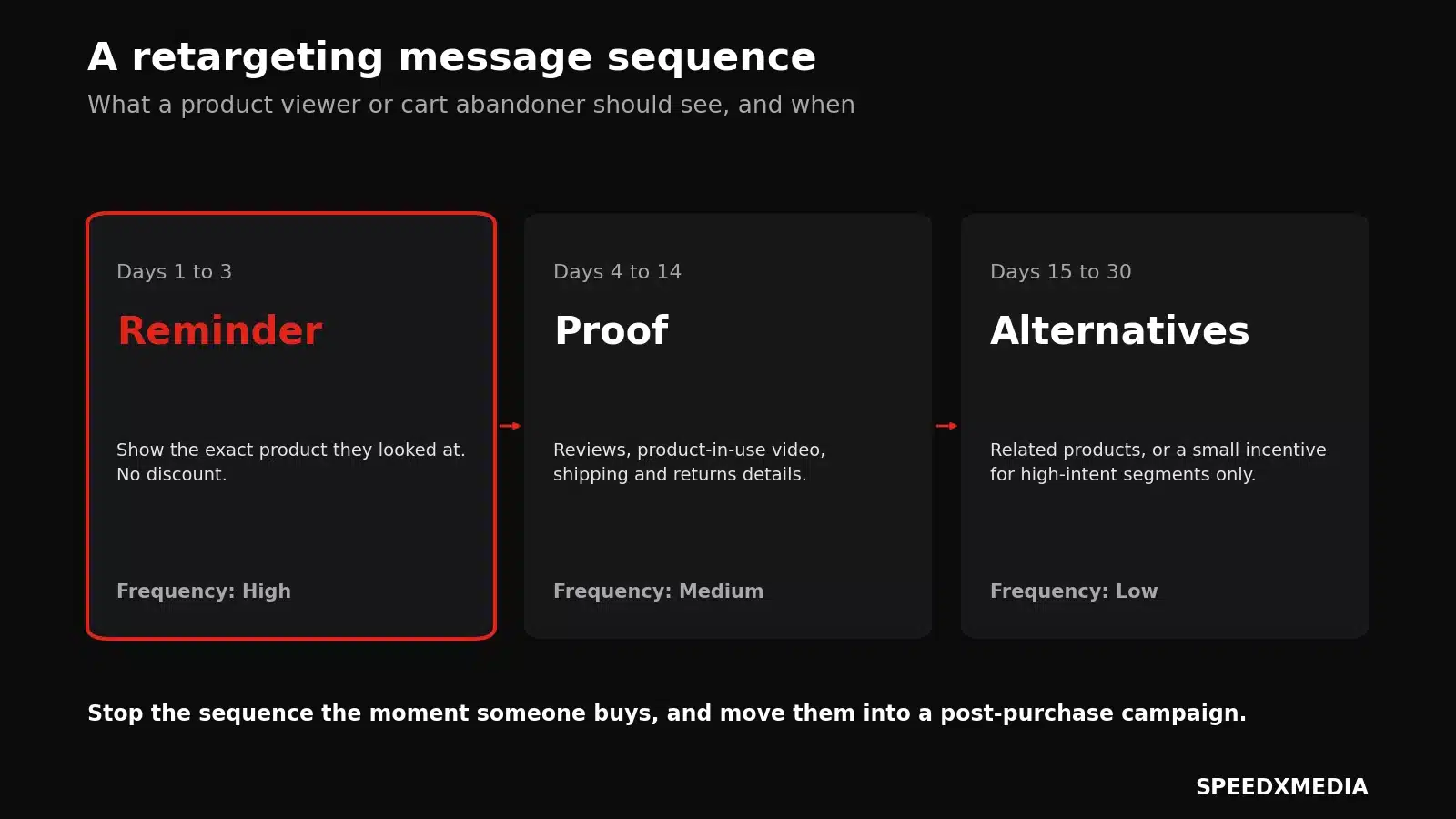
- Sequence the message. Days 1 to 3 are a reminder, days 4 to 14 add proof like reviews, and later days offer alternatives or an incentive.
- Cap frequency so no one sees the same ad several times a day.
- Size the budget to the audience. Retargeting pools are small, so if frequency climbs while results stay flat, you’re spending more than the pool can absorb.
- Measure with a holdout group so you know what retargeting adds on top of sales you’d get anyway.
Our first-party data strategy guide covers the tracking side in more depth, which is where retargeting problems usually start.
How Long Can You Retarget Someone?
Each platform caps how long a person can stay in a retargeting audience. Within that cap, the right window depends on how long your customers take to decide.
| Platform | Default or common setting | Maximum |
|---|---|---|
| Meta website custom audiences | 30 days is a common starting point | 180 days |
| Meta purchase audiences | Varies | 730 days, after a 2026 update |
| Google Ads data segments | 30 days | 540 days |
Sources: Meta developer documentation and Google Ads Help. Meta’s purchase window extension was reported in May 2026.
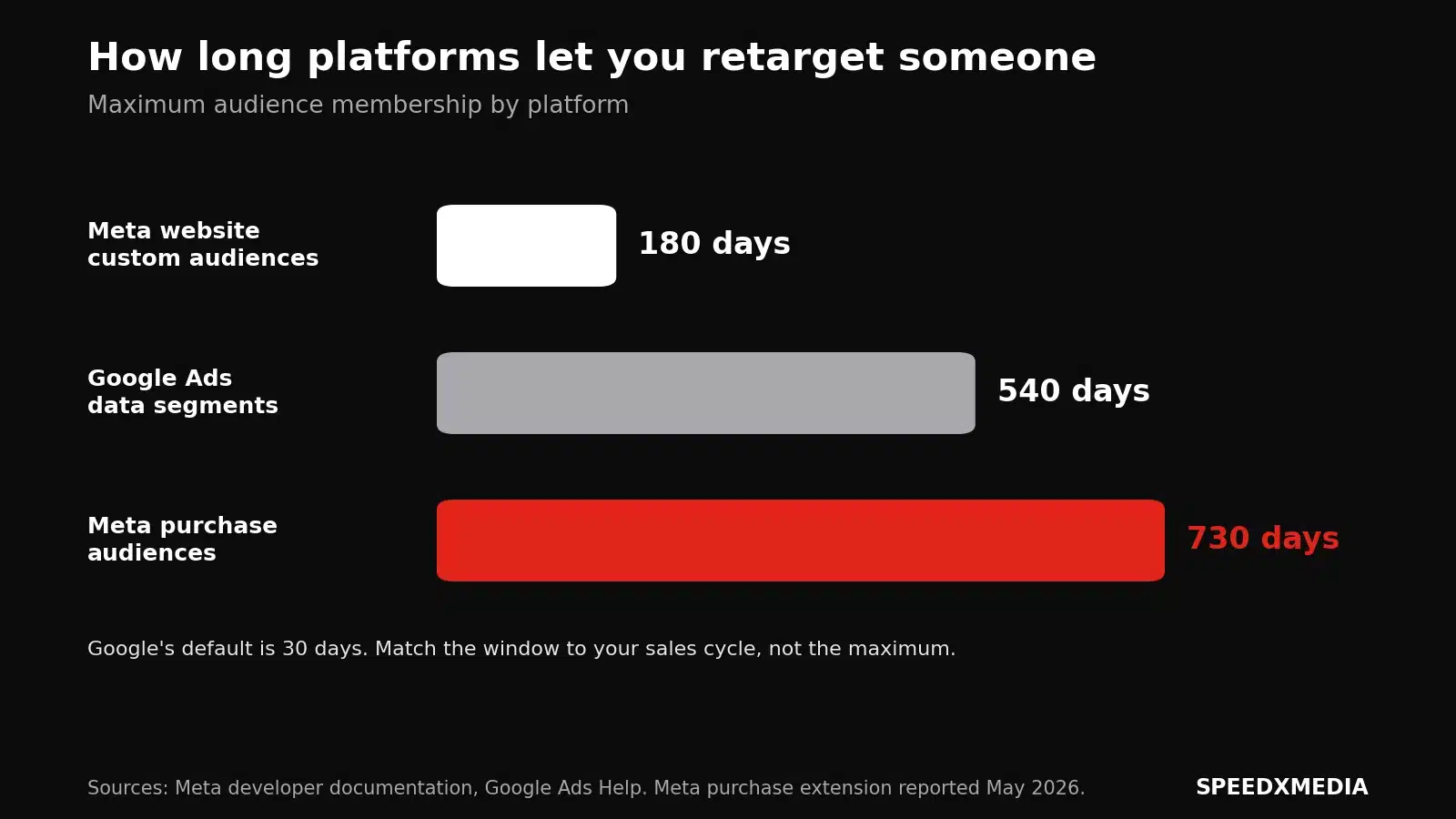
Google’s own advice is to match membership duration to your sales cycle. A shop selling concert tickets might use a few days. A furniture brand or a B2B software company might use several months. Longer isn’t better by default. A person who browsed once five months ago is a cold prospect, not a warm lead.
Retargeting Ad Examples by Segment
The best retargeting ads answer the question that stopped someone from buying. Here’s what that looks like for each segment:
- Checkout abandoner: “Your order is saved. Free returns for 30 days.” It removes the last bit of risk without a discount.
- Cart abandoner: The exact product they added, with a short customer review and the price. Dynamic product ads from your catalog do this automatically.
- Product viewer: A short video of the product in use, or a carousel of related items in case the first one wasn’t quite right.
- Content reader: A case study or guide that answers the next question in their research, with no sales pitch.
- Past customer: A product that pairs with what they bought, or a reminder when a refill is due.
Refresh creative every few weeks. Retargeting audiences are small, so the same people see your ads often, and fatigue sets in faster than it does with prospecting.
Frequency, Exclusions and Budget Leaks
Retargeting budgets usually leak through a handful of setup mistakes:
- Showing ads to people who already bought. Exclude purchasers from acquisition ads, or move them into a separate post-purchase campaign.
- Using one “all visitors, 180 days” audience. It mixes ready-to-buy shoppers with people who bounced months ago.
- Running without a frequency cap. Seeing the same ad over and over turns interest into irritation.
- Letting segments overlap. If someone sits in three audiences, your own campaigns can compete for the same impression.
- Leading with a discount. Offer it too early and you pay a margin cost on sales that would have happened anyway.
Retargeting in 2026: Cookies, Privacy and First-Party Data
The “cookieless future” didn’t arrive the way many guides predicted. Google confirmed in July 2024 that it would not remove third-party cookies from Chrome. In October 2025, it retired most of its Privacy Sandbox technologies. Third-party cookies still work in Chrome.
That doesn’t mean retargeting audiences are complete. Safari and Firefox block third-party cookies by default, and iPhone apps must ask permission before tracking people across other apps. So pixel-based audiences still miss a share of your visitors.
The fix is to rely less on cookies alone. Send conversion data server-side through Meta’s Conversions API and Google’s enhanced conversions. Build customer lists from your email and SMS subscribers, which don’t depend on browser cookies. Our email marketing strategy guide covers how to grow that list, which becomes your most reliable retargeting audience over time.
B2B Retargeting
B2B buying cycles run longer, involve several people and rarely end with an impulse purchase. That changes the strategy in three ways.
- Use longer windows, often 90 to 180 days, because decisions take months.
- Lead with content, not offers. A case study, a comparison guide or a webinar moves a buying committee further than a discount.
- Retarget by page intent. Someone who viewed your pricing page should see a demo invitation, while a blog reader should see the next useful resource.
LinkedIn adds a B2B-specific option: retargeting website visitors and uploaded lists of target companies, so your ads reach the accounts you actually want.
Retargeting After a Big Sale
Sale periods fill your retargeting pools fast. After Black Friday and Cyber Monday, those visitors become your warmest audience for December. Refresh the creative so people don’t keep seeing the sale they skipped, exclude anyone who already bought, and switch the message as the calendar moves. Our guide to Black Friday Facebook ads covers the audience setup for sale week. Our holiday marketing ideas guide shows what to promote once shipping deadlines pass.
How to Measure Whether Retargeting Works
Retargeting reports tend to look better than reality. Platforms count view-through conversions, where someone saw an ad and later bought, even if the ad had nothing to do with the decision. People in retargeting audiences were already interested, so some of them would have bought anyway.
The honest test is a holdout. Exclude a random slice of your retargeting audience, such as 10%, and compare their purchase rate with the group that saw ads. The difference is what retargeting actually adds. Meta and Google both offer lift studies for eligible accounts if you want a more formal version of the same test.
Final Thoughts
Retargeting works best when it respects the person on the other side. A short, useful reminder for someone close to buying earns the sale. A month of identical banners after they bought earns an unsubscribe and a bad impression. Segment by intent, set clear windows, cap frequency and measure honestly, and retargeting stays one of the most efficient parts of your ad budget.
Work With SPEEDXMEDIA
SPEEDXMEDIA builds retargeting strategies across paid social and Google Ads, from tracking setup to creative sequences and holdout testing. If your retargeting spend is climbing without clear results, contact SPEEDXMEDIA or call 442-4-SPEEDX. We’re based in Burbank and work with brands across Los Angeles.