Customer Acquisition Strategy: The 8-Step Growth Framework
- ravi
- Strategy
TL;DR: A customer acquisition strategy is a written plan for winning new customers profitably. It defines who you are targeting, which channels reach them, how they move through the funnel, and the most you can afford to pay for each one. Build it in eight steps: define the customer, set goals and unit economics, sharpen the value proposition, choose channels by intent, build the conversion path, nurture, track to revenue, and reallocate budget on a schedule. The plan only works if you know your allowable customer acquisition cost before you spend.
- What a customer acquisition strategy is
- Why it matters more on a flat budget
- The customer acquisition funnel
- How to build a customer acquisition strategy in 8 steps
- Customer acquisition channels compared
- Seven customer acquisition strategies that work
- How to measure customer acquisition
- How to reduce customer acquisition cost
- Example acquisition plans by business type
- How AI is changing customer acquisition
- Where acquisition plans usually break
Most businesses do not have a customer acquisition strategy. They have a list of channels they happen to be spending on. Google Ads got switched on because a competitor was there. Instagram got a budget because everyone has one. Nobody wrote down what a customer is worth, so nobody can tell you whether any of it is working.
A real customer acquisition strategy starts from the other end: what you can afford to pay for a customer, and which channels can deliver one below that number.
What Is a Customer Acquisition Strategy?
A customer acquisition strategy is a plan that sets who a business is trying to win and which channels it will use to reach them. It also maps how those people move from first contact to purchase, and caps what the business can spend to acquire each customer while staying profitable. Its output is a budget allocation, not a list of tactics.
Tactics are things like “run a lead magnet” or “post three times a week.” A strategy tells you which of those to fund, how much, and when to stop.
Customer acquisition vs retention vs marketing strategy
These three get blurred constantly. A marketing strategy covers positioning, brand, messaging, pricing and every audience a business serves. A customer acquisition strategy is narrower and sits inside it: turning new prospects into paying customers at a profitable cost. Retention is what happens after the first purchase, and it decides how much acquisition you can afford.
Harvard Business Review notes that, depending on the study and the industry, acquiring a new customer is anywhere from five to 25 times more expensive than retaining an existing one. The same article cites Frederick Reichheld of Bain & Company, whose research found that increasing customer retention rates by 5% increases profits by 25% to 95% (HBR). For an acquisition plan, the consequence is direct. A business that keeps customers longer earns more lifetime value from each one, which raises the customer acquisition cost it can afford, which opens up channels that would be unprofitable for a business with high churn. A customer acquisition strategy built without a retention number is built on a guess.
Why It Matters More on a Flat Budget
Marketing budgets are not growing to cover mistakes. Gartner’s 2025 CMO Spend Survey found that marketing budgets stayed flat at 7.7% of overall company revenue, and that 59% of CMOs said they had insufficient budget to execute their strategy. Paid media alone accounted for 30.6% of marketing budgets in that survey (Gartner, May 2025).
A written acquisition strategy pays off in four practical ways:
- Spend goes to the channels that produce customers below your cost ceiling
- Growth becomes more predictable because you know roughly what a customer costs to win
- Sales and marketing work from the same customer definition and the same numbers
- Bad channels get cut on evidence instead of lasting until someone notices
The Customer Acquisition Funnel
Every acquisition plan moves people through the same five stages. What changes between businesses is how long each stage takes and which channels do the work.
| Stage | What the prospect is doing | What they need from you | Channels that usually carry it |
|---|---|---|---|
| Awareness | Discovering a problem or a category | A reason to notice you | Paid social, video, PR, influencers |
| Interest | Learning about possible solutions | Useful, credible information | Content, SEO, email sign-ups |
| Consideration | Comparing options | Proof, pricing clarity, comparisons | Search ads, reviews, case pages, retargeting |
| Intent | Ready to choose | A clear offer and low friction | Search ads, landing pages, sales follow-up |
| Purchase | Converting | A smooth checkout or booking process | Website, CRM, sales team |
Most acquisition problems sit at a specific stage. A business with plenty of traffic and few sales has a consideration or intent problem, not an awareness problem, and buying more awareness will not fix it.
How to Build a Customer Acquisition Strategy in 8 Steps
Each step produces a decision you can write down. If a step does not produce one, it is not finished.
- Define who you are acquiring
- Set goals and unit economics
- Sharpen the value proposition
- Choose channels by intent
- Build the conversion path
- Nurture the people who are not ready yet
- Track to revenue
- Reallocate budget on a schedule
Step 1: Define who you are acquiring
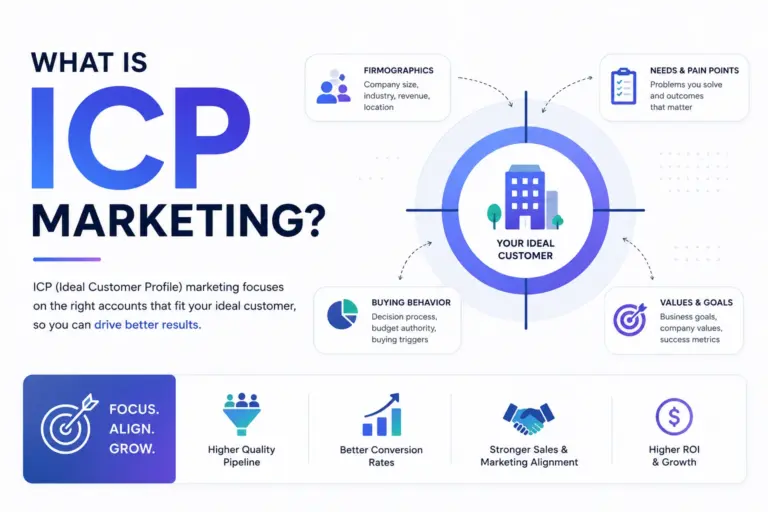
Write an Ideal Customer Profile (ICP): the company or person, the problem, the trigger that sends them looking, and what disqualifies them. Pull it from your best existing customers, not from who you wish you sold to. Our guide to ICP marketing covers how to build one from your own customer data.
Step 2: Set goals and unit economics
Decide how many new customers you need in a period, then calculate what each one can cost. Customer acquisition cost is total sales and marketing spend in a period divided by the number of new customers acquired in that period. LTV to CAC compares what a customer is worth over their lifetime with what it cost to win them.
The most widely cited benchmark comes from SaaS. David Skok of Matrix Partners writes that the best SaaS businesses have an LTV to CAC ratio higher than 3, sometimes as high as 7 or 8, and that many of the best recover their CAC in 5 to 7 months (forEntrepreneurs). Treat those as SaaS reference points, not universal rules. A one-time-purchase ecommerce brand and a subscription business have very different lifetime values, so their allowable CAC is different too.
Step 3: Sharpen the value proposition
Acquisition spend amplifies whatever message you give it. If the offer is unclear, more budget makes the problem more expensive. Write one sentence that says who it is for, what it does for them, and why it beats the alternative they are already considering. Every ad and landing page should be traceable back to that sentence.
Step 4: Choose channels by intent
Separate channels that capture existing demand (search) from channels that create it (social, video, content). If people already search for what you sell, fund capture first. If they do not, you will need channels that create demand, and a longer runway. The channel table further down compares the main options.
Step 5: Build the conversion path
Map every step from click to customer and remove friction. Traffic sent to a weak page raises CAC on every channel at once. McKinsey reports that personalization can reduce customer acquisition costs by as much as 50 percent, lift revenues by 5 to 15 percent, and increase marketing ROI by 10 to 30 percent (McKinsey). Matching the landing page to the ad’s promise is the simplest version of that. Our conversion rate optimization guide walks through finding where visitors drop off.
Step 6: Nurture the people who are not ready yet
Most first visitors will not buy on the first visit. Capture them with an email sign-up, a lead magnet or a retargeting audience, and give them a reason to come back. An email marketing strategy built around the questions prospects ask before buying turns that delay into a pipeline instead of lost spend.
Step 7: Track to revenue
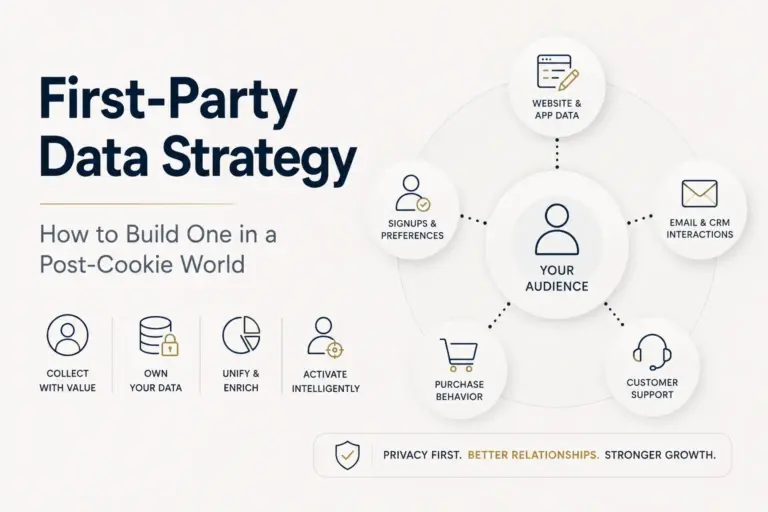
Track conversions to revenue, not to clicks or form fills alone. That usually means connecting your ad platforms, analytics and CRM so a closed sale can be traced to its source. If your data cannot connect a sale back to a channel, you cannot compare channels. A first-party data strategy is now the foundation for this, since platform tracking alone misses more than it used to.
Step 8: Reallocate budget on a schedule
Review channel CAC monthly and move budget toward what performs. Set the review date in advance so it happens whether or not results look alarming. A plan that never shifts budget is a plan nobody is reading.
Customer Acquisition Channels Compared
No channel is best in general. Each one is best at a specific job.
| Channel | Captures or creates demand | Time to first results | How cost behaves | Best fit |
|---|---|---|---|---|
| Google Ads (search) | Captures | Days | Rises with competition for each keyword | Products and services people already search for |
| Meta and paid social | Creates | Days to weeks | Driven by creative quality and audience saturation | Visual products, new categories, retargeting |
| SEO | Captures | Months | Front-loaded effort, low marginal cost later | Topics with steady search demand |
| Content marketing | Creates and captures | Months | Compounds when content keeps ranking | Considered purchases with research phases |
| Converts existing contacts | Immediate once a list exists | Very low per send | Nurturing leads and repeat purchases | |
| Referrals | Creates | Variable | Paid per result through incentives | Businesses where trust drives the decision |
| Influencers and partners | Creates | Weeks | Fee or revenue share per partner | Consumer brands and niche audiences |
| Outbound sales and ABM | Creates | Weeks to months | Driven by team cost per meeting | High-value B2B deals with a defined account list |
If you are deciding between the two largest paid channels, our breakdown of Google Ads vs Facebook Ads compares them on intent, cost and tracking.
Seven Customer Acquisition Strategies That Work
Channels are where you show up. Strategies are how you use them.
1. Capture search demand first
If people already search for what you sell, being absent from those results hands customers to competitors. Paid search covers the gap immediately while SEO builds. Our comparison of SEO vs PPC covers how to split the two.
2. Create demand with paid social creative
For products people do not know to search for, paid social is how they find out. The creative carries the targeting: an ad that clearly shows who the product is for reaches those people more efficiently than any audience setting.
3. Offer something worth an email address
A guide, calculator, sample or consultation captures people at the interest stage and gives you permission to follow up. It works when the offer is specific to the buyer’s problem.
4. Turn customers into a referral channel
Referred customers arrive with trust already built. A simple, visible incentive for both sides is usually enough to start.
5. Personalize the path
Use what you know about the visitor, such as the ad they clicked, their industry or their location, to change the landing page and follow-up. This is where McKinsey’s acquisition cost finding comes from.
6. Retarget with a different message
Someone who visited and left has told you something. Retargeting with the same ad they ignored wastes the second chance. Answer the objection that likely stopped them.
7. Borrow trust through partners
Partners and creators who already have your audience’s attention can introduce you faster than cold ads can. Tie the terms to sales or leads, with reach as a secondary measure.
How to Measure Customer Acquisition
| Metric | Formula | What it tells you |
|---|---|---|
| Customer acquisition cost (CAC) | Sales and marketing spend ÷ new customers | What one customer costs you |
| LTV to CAC ratio | Customer lifetime value ÷ CAC | Whether acquisition is profitable over time |
| CAC payback period | CAC ÷ monthly gross profit per customer | How many months until a customer pays back their acquisition cost |
| Channel CAC | Channel spend ÷ customers from that channel | Which channels to fund and which to cut |
| Lead-to-customer rate | Customers ÷ leads | Whether lead volume is turning into revenue |
| Churn rate | Customers lost ÷ customers at start of period | How fast acquired customers leave, which caps their lifetime value |
Blended CAC hides problems. A strong referral channel can make a losing paid channel look acceptable when everything is averaged together, so calculate CAC by channel as well as overall. For paid channels, return on ad spend gives you the same check at the campaign level.
How to Reduce Customer Acquisition Cost
Customer acquisition cost falls when one of three things improves: more of the people you reach are a good fit, more of them convert, or more of them come back and refer others. Each lever has a specific fix.
- Tighten targeting. Exclude audiences and search terms that never convert. On Google, that means reviewing search terms and adding negatives. On Meta, it means feeding the platform accurate conversion data so it finds better buyers.
- Raise the conversion rate. A landing page that converts twice as well halves the acquisition cost of every channel pointing at it.
- Improve ad quality. Google states that higher quality ads can often lead to lower CPCs (Google Ads Help).
- Increase lifetime value. Retention and repeat purchases do not lower CAC directly, but they raise the CAC you can afford, which changes which channels are profitable.
- Grow the channels with near-zero marginal cost. SEO, email and referrals cost effort up front but very little per extra customer once they work.
Example Acquisition Plans by Business Type
These are illustrative starting points, not case studies. The right mix depends on your numbers.
| Business type | Lead channels | Supporting channels | Number to manage |
|---|---|---|---|
| Ecommerce brand | Meta and paid social, Google Shopping and search | Email and SMS, influencers, retargeting | Blended return on ad spend and repeat purchase rate |
| B2B services firm | Google search, LinkedIn, outbound to target accounts | Content, webinars, email nurture | Cost per qualified opportunity and sales cycle length |
| Local service business | Google search and local listings | Reviews, referrals, retargeting | Cost per booked job |
| Subscription or SaaS | Search, content and SEO | Free trial or demo, partner integrations, paid social | LTV to CAC and payback period |
How AI Is Changing Customer Acquisition
The ad platforms now automate much of the targeting and placement work that used to be done by hand. Google’s Performance Max is a goal-based campaign type that reaches all Google Ads inventory, including YouTube, Display, Search, Discover, Gmail and Maps, from one campaign. Meta’s Advantage+ campaigns automate audience, budget and placement decisions in the same way.
That shifts where the advantage lies. When every advertiser has the same automation, results depend on what you feed it: accurate conversion data, a clear offer, and enough creative variety for the system to match ads to people. Businesses with clean first-party data and strong creative get more out of automation than those without.
Where Acquisition Plans Usually Break
Three failure points account for most of it.
- No ceiling on CAC. Without a maximum acceptable acquisition cost, every channel looks fine until the money runs out.
- Tracking that stops at the lead. A channel producing cheap leads that never close will look like your best performer.
- Budget that never moves. Allocations set at the start of the year and left alone ignore everything the data has said since.
Each of these is fixable in a week. None of them fixes itself.
Final Thoughts
A customer acquisition strategy is mostly arithmetic with a few judgment calls attached. Know what a customer is worth, set what you will pay for one, and hold every channel to that number. The businesses that grow on flat budgets are rarely the ones with the most channels. They are the ones that can tell you which channel produced last month’s customers, and what each one cost.
Work With SpeedXMedia
SpeedXMedia plans and runs customer acquisition across paid advertising, conversion rate optimization and media planning, with the strategy and the execution handled by the same team. If you are spending on acquisition and cannot say what a customer costs you by channel, contact SpeedXMedia or call 442-4-SPEEDX and we will start there.
How much should a business spend on customer acquisition?
There is no universal percentage. Your ceiling is set by customer lifetime value and margin. For context, Gartner's 2025 CMO Spend Survey found total marketing budgets averaged 7.7% of company revenue, and acquisition is only part of that. Start from your maximum allowable CAC, then size the budget to the number of customers you need.
How long does a customer acquisition strategy take to show results?
A customer acquisition strategy shows results on different timelines by channel. Paid search and paid social can produce customers within days of launch. SEO and content usually take months before they contribute meaningfully. Plan for paid channels to carry early acquisition while slower channels build, then rebalance as organic channels start producing.
Should a small business focus on one acquisition channel or several?
Start with one or two channels and run them properly before adding more. Spreading a small budget across five channels leaves each one underfunded and makes the data too thin to judge. Pick the channel closest to existing demand, prove a profitable CAC there, then expand.
Do I need a CRM for customer acquisition?
A CRM becomes necessary once leads go through any follow-up before buying. It records where each lead came from and whether it closed, which is the only way to calculate cost per customer by channel. Ecommerce brands that sell entirely online can often get the same data from their store platform and analytics instead.
How often should a customer acquisition strategy be updated?
Review channel performance monthly and the full customer acquisition strategy at least once a quarter. Update it sooner if acquisition costs move sharply, a new competitor enters, a platform changes how it tracks conversions, or your pricing or retention changes, since each of those shifts the CAC you can afford.